
Showing posts with label Thomas Merton. Show all posts
Showing posts with label Thomas Merton. Show all posts
Wednesday, January 31, 2018

Monday, October 16, 2017
Thomas Merton prayer
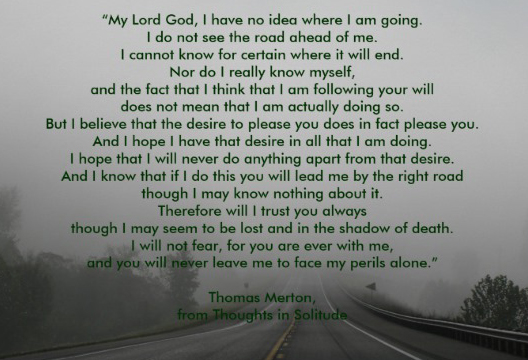
Thomas Merton's prayer from Thoughts in Solitude:
My Lord God, I have no idea where I am going. I do not see the road ahead of me. I cannot know for certain where it will end. Nor do I really know myself, and the fact that I think that I am following your will does not mean that I am actually doing so. But I believe that the desire to please you does in fact please you. And I hope I have that desire in all that I am doing. I hope that I will never do anything apart from that desire. And I know that if I do this you will lead me by the right road, though I may know nothing about it. Therefore will I trust you always, though I may seem to be lost and in the shadow of death. I will not fear, for you are ever with me, and you will never leave me to face my perils alone.
Thursday, October 12, 2017
The Will of God
Thomas Merton on the will of God, one of the "fine ideas in Guardini on Providence:"
the will of God is not a ‘fate’ to which we submit but a creative act in our life producing something absolutely new ... something hitherto unforeseen by the laws and established patterns. Our cooperation (seeking first the Kingdom of God) consists not solely in conforming to laws but in opening our wills out to this creative act which must be retrieved in and by us -- by the will of God.
Friday, October 6, 2017
The Welcome Practice
The video above is a wonderful explanation of the Welcome Practice developed by Mary Mrozowski, one of the founders of Contemplative Outreach and an associate of Fr. Thomas Keating.
As nicely explained by Wisdom Way of Knowing, the practice has three steps:
- Focus or ‘sink in’ to become aware and physically present to the particular experience or upset. Bring your attention to what is happening as sensation in your body. Without analyzing or judging yourself or your state, inwardly tune into what is happening as the physical embodiment of the experience. Don’t try to change anything at this stage – just stay present. ...
- Welcome and lightly name the response that is being triggered by the difficult situation (such as “fear” or “anger” or “pain”). Acknowledge the response as sensation, and recognize that in this moment, if the experience is not being rejected or repressed, it can be endured. Ever so gently, begin to say ‘welcome’ (such as “welcome fear”, etc…) ...
- Transition to a ‘letting go’, whereby the intensity of the situation can recede. This enables the natural fluidity of sensation to come and then go. ...
Sunday, October 1, 2017
Thomas Merton on contemplation
From The New Man:
If we would return to God, and find ourselves in God, we must reverse Adam and Eve's journey, we must go back by the way they came. The path lies through the center of our own soul. Adam and Eve withdrew into themselves from God and then passed through themselves and went forth into creation. We must withdraw ourselves from exterior things, and pass through the center of our souls to find God. We must recover possession of our true selves by liberation from anxiety and fear and inordinate desire.From What is Contemplation?
Why do we think of the gift of contemplation. infused contemplation, mystical prayer, as something essentially strange and esoteric reserved for a small class of almost unnatural beings and prohibited to everyone else? It is perhaps because we have forgotten that contemplation is the work of the Holy Spirit acting on our souls through His gifts of Wisdom and Understanding with special intensity to increase and perfect our love for Him. These gifts are part of the normal equipment of Christian sanctity. They are given to us at Baptism, and if they are given it is presumably because God wants them to be developed.... But it is also true that God often measures His gifts by our desire to receive them, and by our cooperation with His grace, and the Holy Spirit will not waste any of His gifts on people who have little or no interest in them.See this for more.
Subscribe to:
Posts (Atom)